When it comes to outdoor cooking, nothing beats the durability and performance of a custom stainless steel BBQ grill. But finding a manufacturer who can deliver precision metal fabrication—with the right materials, craftsmanship, and attention to detail—is easier said than done.
This case study follows one customer’s journey with Kewei, from initial design challenges to a finished 304 stainless steel grill that exceeded expectations. Here’s how metal fabrication solved real problems and delivered a product built to last.
The Challenge: A Great Design, But Hard to Make
A commercial outdoor kitchen brand approached Kewei with a concept for a premium built-in charcoal grill. They had detailed CAD and 3D drawings and a clear vision: a sleek, heavy-duty grill that could withstand daily use in coastal environments.
But there were problems hiding in the design:
Issue 1: Warping Risk from Thin Sections
The initial design had long, thin panels with a high length-to-cross-section ratio. As any metal fabricator knows, this geometry is prone to warping during welding and cooling. Without design changes, the grill body could distort, causing gaps, misaligned doors, and poor heat retention.
Issue 2: Corrosion Concerns
The customer wanted the grill for a beachfront restaurant. Standard steel wouldn’t survive the salt air. They needed 304 stainless steel—but they weren’t sure about the right thickness or surface finish for maximum durability.
Issue 3: Assembly Fit Issues
The design had multiple components that had to fit together precisely: the firebox, charcoal tray, cooking grates, ventilation dampers, and stand. Even small dimensional errors would cause assembly problems.
Issue 4: Heat Management
The customer wanted a grill that could handle both low-and-slow smoking (around 110°C) and high-heat searing (350°C+). The ventilation design needed to deliver precise airflow control.
The Solution: Kewei’s Metal Fabrication Process
Kewei’s engineering team got to work. Instead of simply quoting the project as-is, they provided Design for Manufacturability (DFM) feedback—identifying potential problems and proposing solutions before production started.
Step 1: Material Selection — 304 Stainless Steel
The team confirmed that 304 stainless steel was the right choice for the coastal environment. Type 304 offers excellent corrosion resistance and is widely used in food-grade applications.
Key material decisions:
- Body panels: 2.0mm thickness for strength and heat retention
- Hardware: All fasteners and hinges upgraded to stainless steel to prevent rust
Step 2: Design Optimization to Prevent Warping
Kewei’s engineers modified the panel design to reduce the warping risk while maintaining the customer’s aesthetic vision:
- Added stiffening ribs (reinforcement bends) to long panels, increasing rigidity without changing exterior appearance
- Adjusted the weld sequence to minimize heat input and allow controlled cooling
- Reduced the number of long continuous welds, replacing some with intermittent welds where structurally acceptable
These changes eliminated the warping issue without compromising the design—and actually reduced the material cost.
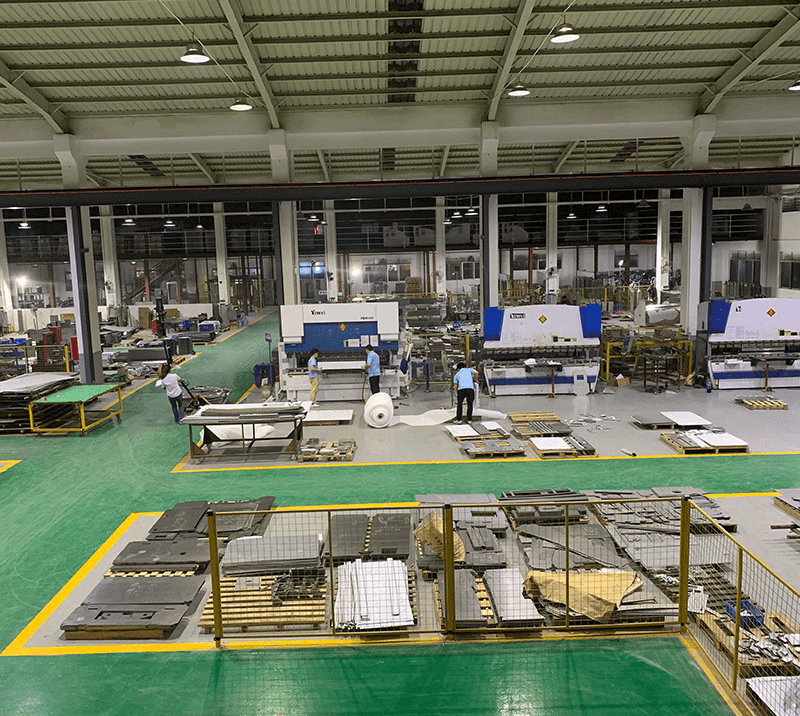
Step 3: Precision Cutting and Bending
Kewei used its in-house CNC laser cutting and CNC bending equipment to produce the components:
The ventilation system was particularly critical. The customer wanted precise temperature control from low-and-slow smoking to high-heat searing. Kewei designed:
- Bottom intake vents with sliding dampers (15-25% of the firebox cross-sectional area for optimal airflow)
- Top exhaust vents sized at 60-80% of the intake area to maintain positive pressure inside the cooking chamber
- This design keeps smoke circulating around the food before exhausting, enhancing flavor
Step 4: TIG Welding — The Quality Difference
All welding was done using TIG (Gas Tungsten Arc Welding) —the gold standard for stainless steel fabrication:
- Clean, consistent welds with minimal spatter
- No discoloration or “burn” marks on visible surfaces
- Full penetration on structural joints for strength
- All food-contact surfaces polished smooth for hygiene and easy cleaning
Step 5: Surface Finishing
The customer chose a brushed finish—not too shiny, not too dull. This finish:
- Hides minor scratches and fingerprints
- Looks professional and modern
- Is easy to clean with standard grill brushes
Final touch: The customer’s logo was laser-engraved on the front panel—a permanent, high-end branding detail.
Step 6: Assembly and Testing
Before shipping, every grill was fully assembled and tested:
- Load-bearing test to confirm the stand and firebox could hold full charcoal loads
- Heat test to verify temperature range (110°C to 350°C+) with the ventilation system
- Fit check—all components aligned correctly, doors opened smoothly, grates sat flat
The Result: What the Customer Got
Product: Custom 304 stainless steel built-in charcoal grill
Features:
- 2.0mm thick 304 stainless steel body and firebox
- Adjustable charcoal tray for heat control
- Dual-airflow ventilation system (bottom intake + top exhaust)
- Removable warming rack
- Easy-slide ash tray for cleanup
- Brushed finish with custom logo engraving
- Heavy-duty stainless steel stand with side shelves
Customer Feedback:
“The grills arrived on time, assembled perfectly, and have been running daily in our beachfront restaurant for six months now. No rust, no warping, and they look as good as day one. Kewei’s team caught design issues we didn’t even see and fixed them before production. That’s the kind of partner every brand needs.”
— Head of Product, Commercial Outdoor Kitchen Brand
Key Takeaways for Your Custom Metal Project
| Challenge | Kewei’s Solution |
|---|---|
| Warping risk | Design optimization + controlled welding sequence |
| Corrosion concerns | 304 stainless steel + proper surface finish |
| Assembly fit issues | Precision CNC cutting and bending + full assembly test |
| Heat management | Engineered ventilation system with precise airflow control |
| Tight timeline | Integrated in-house process + active production scheduling |
Why 304 Stainless Steel for BBQ Grills?
If you’re wondering why 304 stainless steel is the industry standard, here’s the quick answer:
| Property | Benefit |
|---|---|
| Corrosion resistance | Survives rain, salt air, and humidity |
| Heat tolerance | Won’t warp or discolor at grilling temperatures (350°C+) |
| Food safety | Non-reactive, no harmful leachates |
| Durability | Lasts decades with proper care |
| Appearance | Brushed or polished finishes look professional |
| Value | More affordable than 316, excellent for most applications |
Ready to Build Your Custom Grill?
Kewei offers full OEM/ODM services for custom BBQ grills:
- Full customization: Size, material, color, logo, packaging
- Professional engineering support: DFM review and design optimization
- In-house production: Laser cutting, CNC bending, TIG welding, finishing, assembly
- Quality guaranteed: 100% inspection before shipping
- Flexible quantities: From prototypes to full production runs
Contact Us
Click here: Contact Us
Email: David@zhmfr.com
Author:David Wu
URL: https://zhmfr.com
video URL:https://www.youtube.com/@David-OEM
China Kewei Intelligent Technology Co., Ltd
Address:No. 23, Yexing Road, Xiangxi Industrial Zone, Liaobu Town, Dongguan City, Guangdong Province, China
With our profound expertise in customized sheet metal manufacturing services, CNC milling and turning, and metal stamping processing, we meet the complex needs of the automation equipment industry, new energy storage industry, and manufacturing industry. Our service portfolio includes automation equipment enclosures, precision mechanical parts, energy storage cabinet enclosures, and other customized metal products. We use advanced laser cutting, welding, and forming technologies to produce parts with strict tolerances and excellent surface finish. Whether you need small batch prototypes for research and development or large-scale production for assembly lines, our scalable solutions ensure the quality, cost-effectiveness, and on-time delivery of your industrial projects
相关文章:
 The Complete Guide to Sheet Metal Fabrication: Processes, Materials, and Best Practices
Custom Cut Sheet Metal: A Complete Guide for Buyers and Engineers
The Complete Guide to Sheet Metal Fabrication: Processes, Materials, and Best Practices
Custom Cut Sheet Metal: A Complete Guide for Buyers and Engineers
 Custom Metal Enclosures in China: Your Complete Guide to OEM Sheet Metal Housings
 Custom Sheet Metal Solutions: What Kewei Can Do for Your Business