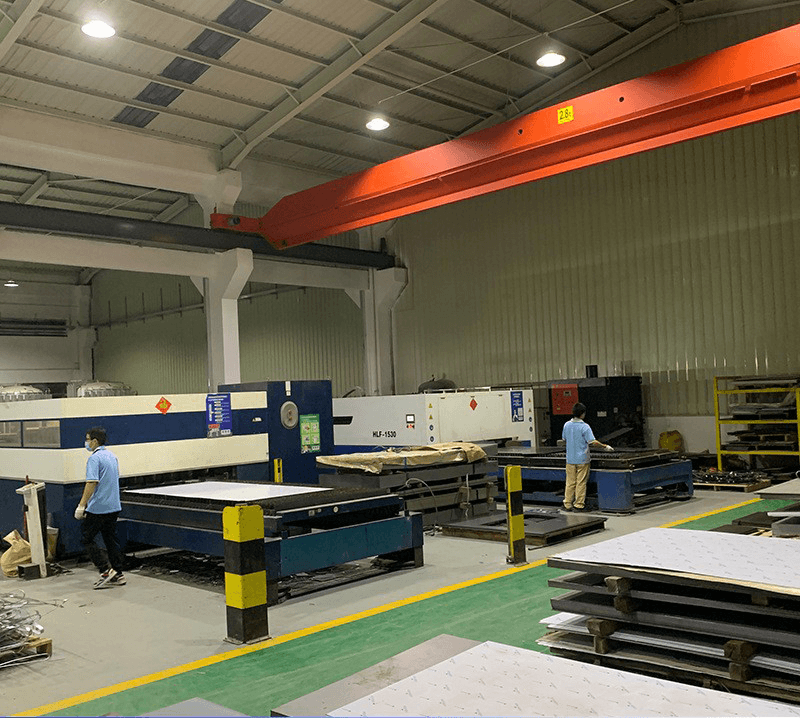
1. Nitrogen — Best Cut Quality, Highest Cost
Nitrogen is an inert gas — it doesn’t react chemically with metal. Its job is purely to blow away molten metal while blocking oxygen from reaching the cut surface, preventing oxidation.
Click to learn more:Custom Cut Sheet Metal
The results:
The cut edge appears silver-white or bright gray — very clean, with no oxide layer. It’s ready for welding or painting without any secondary processing.
Best for:
| Material | Why |
|---|---|
| Stainless steel | Most common use — prevents blackening on the cut edge |
| Aluminum and alloys | Also requires oxidation protection |
| Brass, copper | Suitable for all non-ferrous metals |
| Electroplated steel | Protects the coating from being damaged |
Drawback:
Nitrogen consumption is very high, especially when cutting thick materials. In some cases, the gas cost alone can approach the value of the part itself.
Summary: Choose nitrogen if you need a clean appearance and want to skip secondary processes. Be prepared for higher gas costs.
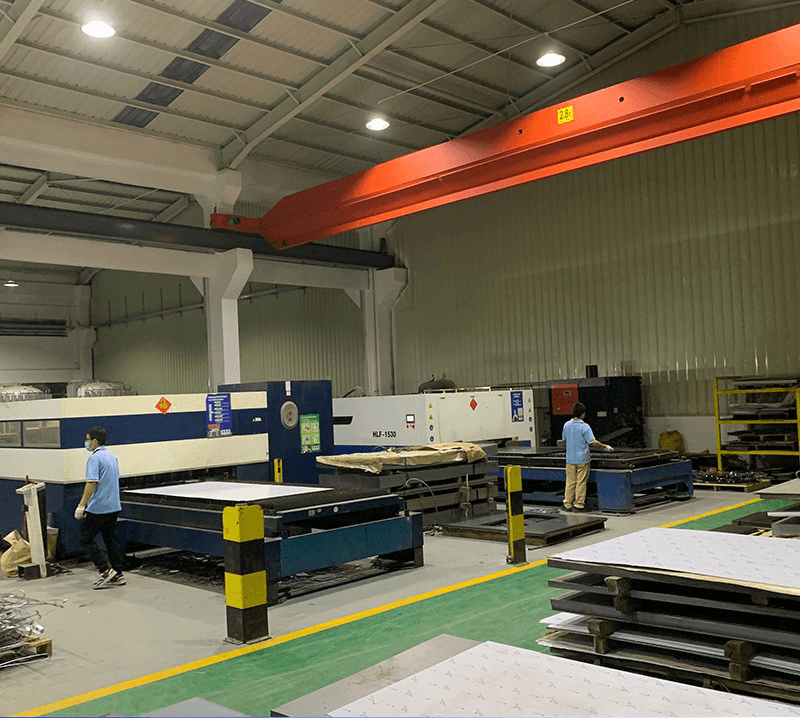
2. Oxygen — Fastest and Thickest Cutting, But Edges Turn Black
Oxygen works very differently from nitrogen. It doesn’t just blow away molten metal — it also triggers an oxidation reaction with the hot metal. This reaction itself releases heat, effectively adding extra energy to the laser.
The results:
Thanks to the extra heat from oxidation, oxygen delivers:
- The ability to cut thicker materials
- Faster cutting speeds
But there’s a price: the cut edge develops an oxide layer, turning black or dark yellow. The surrounding material also becomes hardened due to the quenching effect, which can affect secondary machining.
Best for:
| Material | Why |
|---|---|
| Carbon steel | Most common — highest efficiency |
| Thick steel plates | Oxygen is the go-to for thick materials |
| Structural steel, tool steel | All carbon-based steels work well |
Not suitable for:
Stainless steel, aluminum, or copper — oxygen cuts these poorly and causes severe oxidation.
Summary: Choose oxygen for speed and thickness capability. Be prepared to deal with oxide layers that require grinding or removal before further processing.
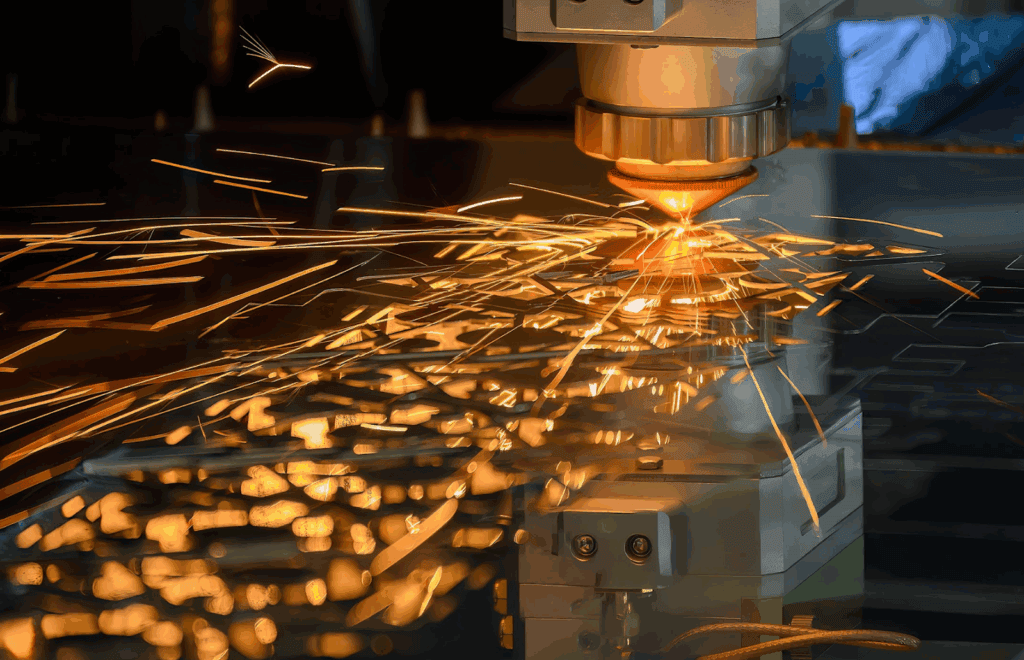
3. Compressed Air — Lowest Cost, Moderate Quality
Compressed air is about 78% nitrogen and 21% oxygen. So the cutting effect sits somewhere between nitrogen and oxygen.
The results:
The cut edge develops a slight yellow tint (due to the oxygen content causing some oxidation), but not as severe as with pure oxygen. Cutting speed is similar to nitrogen, but slower than oxygen.For slightly thicker materials, burrs may occur and require secondary processing.
Biggest advantage: cost. Compressed air comes from an air compressor — no buying gas, no swapping cylinders. The only ongoing costs are electricity and filter maintenance.
Best for:
| Material | Why |
|---|---|
| Thin stainless steel | Works fine if edge appearance isn’t critical |
| Aluminum and alloys | Acceptable results |
| Galvanized steel | Reduces oxide film formation |
| Non-metal materials | Cost advantage is significant |
Not suitable for:
Thick plates, or parts where edge appearance is critical (decorative parts, exposed components).
Summary: Choose air for thin materials, when appearance isn’t critical, and when cost savings are important.
Quick Comparison Table
| Factor | Nitrogen | Oxygen | Compressed Air |
|---|---|---|---|
| Cut edge | Silver-white, no oxidation | Black/dark yellow, oxidized | Light yellow, slight oxidation |
| Cutting capability | Medium | Best (thickest capacity) | Medium (similar to nitrogen) |
| Cutting speed | Fast | Fastest | Medium-fast |
| Post-processing | Not needed | Grinding or oxide removal required | Depends on requirements |
| Cost | Highest | Medium | Lowest |
| Primary use | Stainless steel, aluminum, appearance parts | Carbon steel, thick plates | Thin plates, cost-sensitive jobs |
Material-Based Recommendations
| Material | Recommended Gas | Why |
|---|---|---|
| Stainless steel (thin) | Nitrogen or air | Nitrogen gives clean edges; air saves cost |
| Stainless steel (thick) | Nitrogen | Thick material needs the clean edge quality |
| Carbon steel (standard) | Oxygen | Highest efficiency, fastest cutting |
| Carbon steel (thin) | Air or oxygen | Air saves cost; oxygen gives faster speed |
| Aluminum and alloys | Nitrogen or air | Oxidation prevention is key |
| Galvanized steel | Air or nitrogen | Air is cheaper; nitrogen gives better finish |
Summary
Choosing the right assist gas is ultimately about balancing quality, speed, and cost:
- If you need the best edge quality (clean, no post-processing) → Choose nitrogen, and accept the higher gas cost.
- If you need maximum speed and thickness capability → Choose oxygen, and deal with the dark edge.
- If you’re cutting thin materials and want to save money → Choose compressed air, and accept moderate quality.
There’s no single “best” gas — only the one that best fits your process requirements. Once you know what your product demands, the choice becomes clear.
Attention: Regardless of which gas is selected for laser cutting, the cutting surface structure has been damaged and surface treatment is required to delay the rusting time of the parts
Contact Us
Click here: Contact Us
Email: [email protected]
Author:David Wu
URL: https://zhmfr.com
video URL:https://www.youtube.com/@David-OEM
China Kewei Intelligent Technology Co., Ltd
Address:No. 23, Yexing Road, Xiangxi Industrial Zone, Liaobu Town, Dongguan City, Guangdong Province, China
With our profound expertise in customized sheet metal manufacturing services, CNC milling and turning, and metal stamping processing, we meet the complex needs of the automation equipment industry, new energy storage industry, and manufacturing industry. Our service portfolio includes automation equipment enclosures, precision mechanical parts, energy storage cabinet enclosures, and other customized metal products. We use advanced laser cutting, welding, and forming technologies to produce parts with strict tolerances and excellent surface finish. Whether you need small batch prototypes for research and development or large-scale production for assembly lines, our scalable solutions ensure the quality, cost-effectiveness, and on-time delivery of your industrial projects
相关文章:
 The Complete Guide to Sheet Metal Fabrication: Processes, Materials, and Best Practices
Custom Cut Sheet Metal: A Complete Guide for Buyers and Engineers
The Complete Guide to Sheet Metal Fabrication: Processes, Materials, and Best Practices
Custom Cut Sheet Metal: A Complete Guide for Buyers and Engineers
 Custom Metal Enclosures in China: Your Complete Guide to OEM Sheet Metal Housings
 Custom Sheet Metal Solutions: What Kewei Can Do for Your Business