When you’re developing a new product, there’s a question that comes up a lot: for this part I’m holding, should I use 3D printing for prototyping, or go straight to sheet metal fabrication?
Both processes can make metal parts, but they work completely differently. Pick the right one—you save time and money. Pick the wrong one—you’ll run into problems down the road. Let’s clear this up.
The Basic Difference
3D printing is additive manufacturing—building up material layer by layer, “growing” the part from nothing. No matter how complex the internal structure or how many cavities there are, it handles them the same way.
Sheet metal fabrication is subtractive forming—taking a flat sheet of metal, cutting it with a laser, bending it on a press brake, and welding it together to create a three-dimensional part.
Sounds like 3D printing is more advanced? Not really. These two processes solve different problems.
Here’s a helpful way to think about it: 3D printing is like adding layers of clay to a sculpture, while sheet metal fabrication is like a tailor cutting and sewing fabric into clothes. Each has its own job.
Three Key Factors: Quantity, Size, and Purpose
1. Batch Size Determines Cost Structure
3D printing doesn’t need molds or tooling. Making one piece or ten—the cost per part stays about the same. But when quantities go up, the cost just doesn’t come down.
Sheet metal processing requires some mold costs in areas where the product has protrusions or is difficult to process. The initial cost is higher than 3D printing. But that’s a one-time expense—once it’s spread out, the cost per part drops significantly. When you’re making hundreds or thousands of parts, sheet metal can be 30% or more cheaper per piece than 3D printing.
Choose 3D printing when: You only need 1 to maybe 50 parts, especially when you’re still iterating the design. No tooling commitment—just tweak the CAD file and print again. No hassle.
Choose sheet metal when: You’re making a few hundred parts or more, and the design is mostly finalized. Sheet metal gets more economical the more you make.
2. Part Size—3D Printing Has Limits
Metal 3D printers have limited build volumes. Larger parts either can’t be printed at all or have to be split into sections and joined later—which creates a whole new set of problems.
Sheet metal can handle a much wider range of sizes—from small brackets the size of your palm to equipment enclosures several meters long. That’s a real practical difference. Big parts almost always go to sheet metal.
3. Complexity vs. Mechanical Reliability
3D printing can do internal channels, lattices, honeycomb structures—things sheet metal can’t even dream of. But sheet metal has something 3D printing struggles with: consistent, predictable material properties.
Sheet metal uses standard, well-understood materials—304 stainless, 5052 aluminum, etc. What you see on the spec sheet is what you get. There are decades of real-world data to back it up.
Metal 3D printing is different—parameters like laser power, scan speed, and powder quality all affect the final material properties. Getting it certified (say, for PPAP or aerospace requirements) is a much bigger headache than it is for sheet metal.
Common Scenarios—Which One Works?
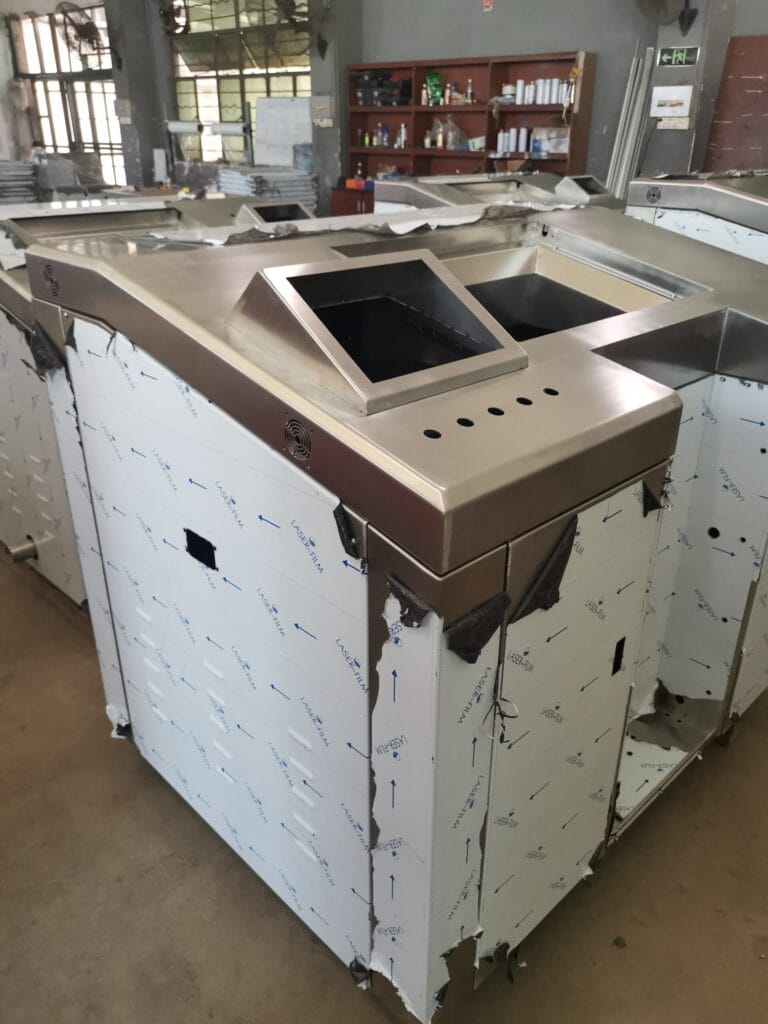
Making enclosures, chassis, brackets, battery boxes—sheet metal is the standard choice. 3D printing can do it, but it’ll cost more than it’s worth. These parts are meant to be cut and bent from flat sheet. It just fits.
Parts with complex internal channels or lattice structures—think heat exchangers, lightweight structural brackets—3D printing has a natural advantage. Sheet metal simply can’t do these.
During prototyping, a lot of teams will 3D print early samples to validate the design, then switch to sheet metal for production once the design is locked. This two-stage approach is actually quite common now—it controls risk without slowing things down.
Don’t Get Confused About Precision
Some people assume 3D printing is more precise. It depends on what you’re measuring.
Sheet metal precision varies: holes on the same flat plane can be cut to ±0.1–0.2mm—pretty good. But once you’re measuring across a bend, tolerance opens up because of springback and accumulated angle error—typically ±0.5mm or more.
3D printing is more consistent across the whole part—layer-by-layer deposition tends to be uniform, so you don’t get the “this feature is precise, that one isn’t” problem.
When designing, if your hole position crosses a bend line, make sure you give it enough tolerance. This detail gets overlooked a lot—and it’s exactly where problems show up.
Bottom Line
At the end of the day, 3D printing and sheet metal processing have their own advantages, depending on which production condition is more suitable for you
- Complex internal geometry, very small quantities, fast iteration → 3D printing
- Enclosures, brackets, structural parts, larger sizes → sheet metal fabrication
- Prototype with 3D printing, then switch to sheet metal for production → this two-stage approach works well in real projects
Contact Us
Click here: Contact Us
Email: David@zhmfr.com
Author:David Wu
URL: https://zhmfr.com
video URL:https://www.youtube.com/@David-OEM
China Kewei Intelligent Technology Co., Ltd
Address:No. 23, Yexing Road, Xiangxi Industrial Zone, Liaobu Town, Dongguan City, Guangdong Province, China
With our profound expertise in customized sheet metal manufacturing services, CNC milling and turning, and metal stamping processing, we meet the complex needs of the automation equipment industry, new energy storage industry, and manufacturing industry. Our service portfolio includes automation equipment enclosures, precision mechanical parts, energy storage cabinet enclosures, and other customized metal products. We use advanced laser cutting, welding, and forming technologies to produce parts with strict tolerances and excellent surface finish. Whether you need small batch prototypes for research and development or large-scale production for assembly lines, our scalable solutions ensure the quality, cost-effectiveness, and on-time delivery of your industrial projects
相关文章:
 Custom Cut Sheet Metal: A Complete Guide for Buyers and Engineers
The Complete Guide to Sheet Metal Fabrication: Processes, Materials, and Best Practices
Custom Cut Sheet Metal: A Complete Guide for Buyers and Engineers
The Complete Guide to Sheet Metal Fabrication: Processes, Materials, and Best Practices
 Custom Metal Enclosures in China: Your Complete Guide to OEM Sheet Metal Housings
 Differences Between Sheet Metal Parts and Machined Parts: How to Tell Them Apart