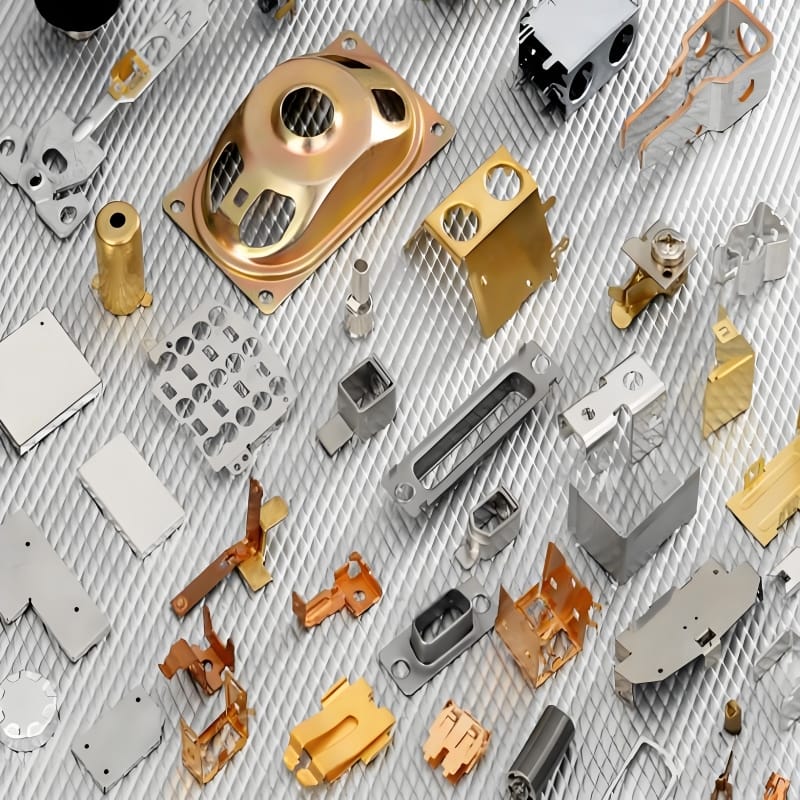
If you need precision metal parts manufactured efficiently and cost-effectively, understanding the metal stamping process is essential. From automotive brackets and electronic connectors to medical device components and appliance parts, stamping is one of the most versatile and high-speed manufacturing methods available.
This guide explains everything you need to know about the metal stamping process—how it works, the different types, common materials, design tips, quality considerations, and how to choose the right custom metal stamping services provider.
What Is the Metal Stamping Process?
The metal stamping process uses a press and custom tooling (dies) to transform flat sheet metal into specific shapes. Each press stroke performs operations like cutting, punching, bending, embossing, or drawing.
The core principle has been around for thousands of years—coin striking dates back to 700 BCE—but modern processing methods have advanced dramatically . Today’s stamping operations are highly automated, utilizing sophisticated presses and precision tooling to achieve tolerances down to ±0.01mm.
The key advantage? Once the tooling is created, per-piece costs drop dramatically at higher volumes—making stamping ideal for runs from thousands to millions of parts.

The Stamping Process Step by Step
The typical metal stamping process follows several key stages :
1. Design & Tooling
Engineers create a CAD design of the product, followed by detailed die design. Tooling design determines the die size, tonnage capacity required, and critical factors involved in the stamping operations .
2. Material Preparation
The chosen metal is selected and prepared for the stamping press. Materials commonly used include steel, stainless steel, aluminum, brass, copper, and nickel alloys .
3. Stamping Process
The metal is fed into the stamping press, where the die cuts or shapes the material. Different press configurations serve different purposes—progressive, compound, or transfer dies.
4. Secondary Operations
Depending on the design, additional techniques may be applied: punching, bending, flanging, coining, tapping, deburring, welding, or finishing .
Main Types of Metal Stamping
Progressive Die Stamping
The metal strip passes through multiple stations, each performing a specific operation. Each station’s actions build on prior work, resulting in a finished part at the end . This is the most common choice for high-volume precision small parts like connectors and terminals .
Best for: High-volume production of small to medium parts with complex features.
Compound Die Stamping
A single station performs multiple operations simultaneously. This approach is efficient for medium-volume parts with simpler shapes.
Best for: Simple shapes, medium production volumes.
Transfer Die Stamping
Robotic arms or automated systems transfer parts between stations within the press. This method is typically used for larger part sizes like automotive closures and structural elements .
Best for: Large parts, complex assemblies.
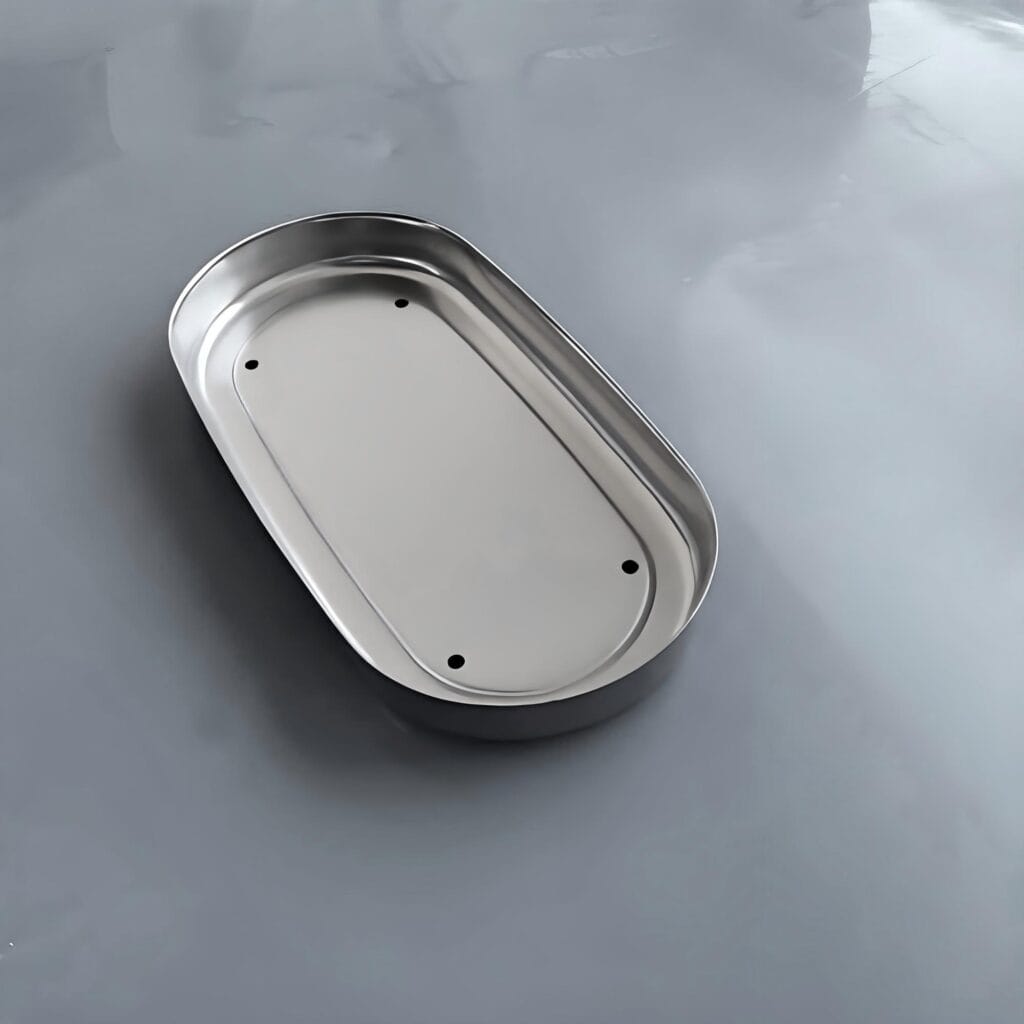
Deep Draw Stamping
The process of punching a sheet metal blank into a die and forming it into a shape—when the depth exceeds the diameter, it’s called “deep drawing” .
Best for: Cylindrical or cup-shaped parts, RFI shields, housings.
Materials for Custom Metal Stampings
Custom metal stamping can work with a wide range of materials :
| Material | Key Properties | Common Applications |
|---|---|---|
| Cold-rolled steel (CRS) | Strong, cost-effective, good surface finish | Brackets, enclosures, automotive parts |
| Stainless steel (304/316) | Corrosion-resistant, durable | Medical, food processing, outdoor equipment |
| Aluminum (5052/6061) | Lightweight, good strength-to-weight ratio | Electronics, automotive, aerospace |
| Brass/Copper | Excellent electrical/thermal conductivity | Electrical terminals, decorative parts |
| High-strength alloys (Monel, Inconel) | Extreme heat/corrosion resistance | Aerospace, defense applications |
Stampable thickness typically ranges from 0.5mm to 3mm
Design Tips for Manufacturability (DFM)
Good design makes stamping easier, cheaper, and more reliable. Here are key guidelines :
| Design Factor | Guideline | Why It Matters |
|---|---|---|
| Internal bend radius | ≥ 1.0–1.5× material thickness | Prevents cracking during forming |
| Hole-to-bend distance | At least 2–3× thickness from bend line | Prevents hole distortion during bending |
| Minimum web/spacing | 1.0–2.0× thickness between features | Prevents weak edges and distortion |
| Internal corners | Radius ≥ 0.5× thickness | Extends die life, prevents stress points |
| Bend relief | Add small notches at bend ends | Prevents tearing at the bend intersection |
Critical note about grain direction: Bends made perpendicular to the grain are stronger and less susceptible to cracking than bends made parallel to the grain <.
Common Stamping Defects and How to Fix Them
Even with good design, stamping problems can occur. Here are the most common issues and solutions :
Click to learn more:Tooling and Fixture Costs in Sheet Metal Fabrication
| Defect | Cause | Corrective Action |
|---|---|---|
| Cracking/Tearing | Bend radius too small; bend parallel to grain | Increase bend radius; reorient part relative to grain direction |
| Springback | Material strength; insufficient die compensation | Over-bend the die; use coining to set the bend permanently |
| Excessive burrs | Worn cutting edge; improper clearance | Sharpen/regrind die; adjust punch-to-die clearance |
| Wrinkling | Insufficient blankholder force | Increase blankholder pressure; incorporate draw beads |
| Distortion/Warping | Uneven stress relief | Add stiffening ribs; incorporate flattening operations |
| Parts not flat | Incoming coil material not flat | Adjust coil feeder and straightener equipment |
Why Choose Custom Metal Stamping Services?
Custom metal stamping offers several advantages:
- High-speed production – cycle times as fast as several parts per second
- Cost efficiency – per-piece cost decreases dramatically with volume
- Complex geometries – multiple forming steps in one die set
- Material versatility – works with almost all sheet metal alloys
- Consistency – tight tolerances maintained across large batches
What Information Does a Supplier Need for a Quote?
For an accurate quote on custom metal stampings, prepare:
- CAD drawing or 3D model (PDF, DWG, STEP, or IGES)
- Material specification (grade and thickness)
- Estimated annual quantity (critical for tooling cost allocation)
- Surface finish requirements (plating, powder coating, etc.)
- Tolerance requirements for critical features
- Industry standards
Contact Us
Click here: Contact Us
Email: [email protected]
Author:David Wu
URL: https://zhmfr.com
video URL:https://www.youtube.com/@David-OEM
China Kewei Intelligent Technology Co., Ltd
Address:No. 23, Yexing Road, Xiangxi Industrial Zone, Liaobu Town, Dongguan City, Guangdong Province, China
With our profound expertise in customized sheet metal manufacturing services, CNC milling and turning, and metal stamping processing, we meet the complex needs of the automation equipment industry, new energy storage industry, and manufacturing industry. Our service portfolio includes automation equipment enclosures, precision mechanical parts, energy storage cabinet enclosures, and other customized metal products. We use advanced laser cutting, welding, and forming technologies to produce parts with strict tolerances and excellent surface finish. Whether you need small batch prototypes for research and development or large-scale production for assembly lines, our scalable solutions ensure the quality, cost-effectiveness, and on-time delivery of your industrial projects
相关文章:
 The Complete Guide to Sheet Metal Fabrication: Processes, Materials, and Best Practices
Custom Cut Sheet Metal: A Complete Guide for Buyers and Engineers
The Complete Guide to Sheet Metal Fabrication: Processes, Materials, and Best Practices
Custom Cut Sheet Metal: A Complete Guide for Buyers and Engineers
 Custom Metal Enclosures in China: Your Complete Guide to OEM Sheet Metal Housings
 Custom Sheet Metal Solutions: What Kewei Can Do for Your Business