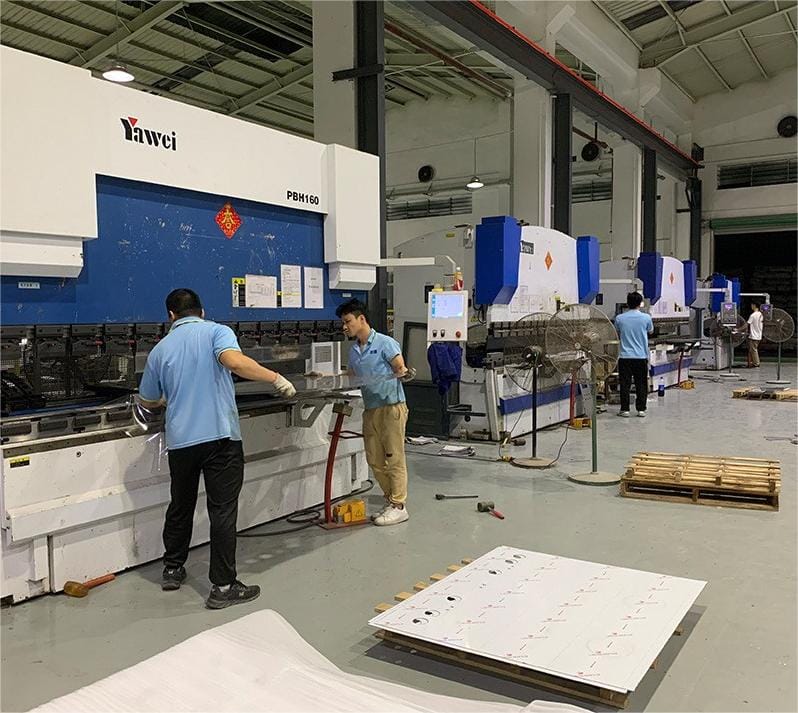
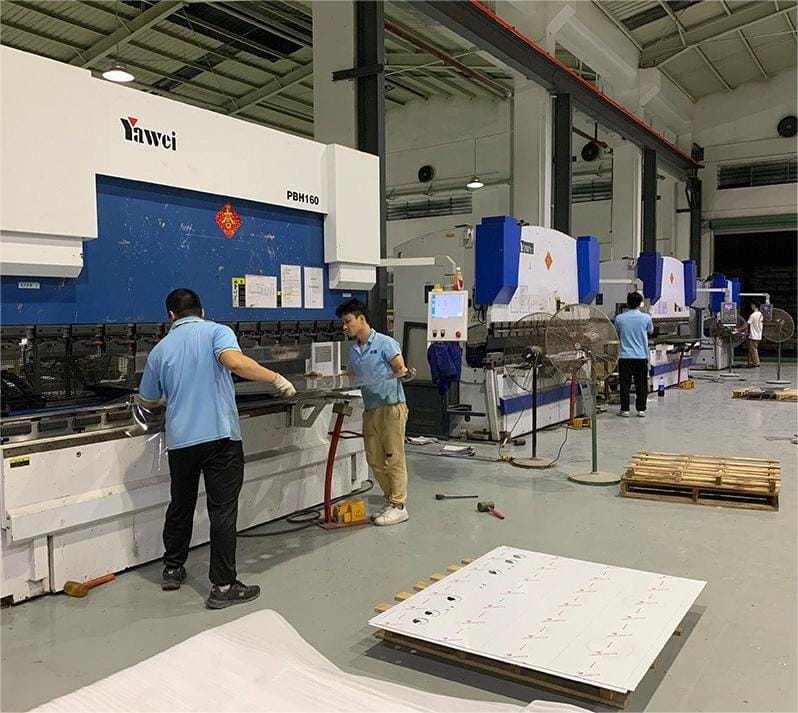
In any sheet metal workshop, few things are more frustrating than this: you program a perfect 90° bend, but the actual measured angle comes out at 91.5° – or even worse. You tweak the backgauge position repeatedly, yet when you go into full production, the angles still fluctuate unpredictably from part to part.
The culprit behind this headache is springback. It is not simply the material being “stubborn” – it is the inevitable elastic recovery that happens after any plastic deformation. While textbooks tell you that “springback is proportional to yield strength,” in real‑world production, grain direction, tool wear, and hydraulic deflection are the true hidden killers that determine whether you hit your target.
This guide moves beyond theoretical formulas. We will tackle springback control from three proven angles: material sourcing, process compensation, and tooling/machine correction – all backed by real shop‑floor experience.
1. Rethinking Springback: Don’t Just Look at Tensile Strength
Most process manuals tell you to calculate springback based on tensile strength (σb) and elastic modulus (E). But in actual production, different batches of the same grade – whether hot‑rolled or cold‑rolled – can show springback variations of 0.5° to 1.5°.
Trap #1: Ignoring Fluctuations in the Yield Ratio (σs/σb)
When the yield ratio is too high, the plastic deformation range narrows, and elastic recovery becomes more severe.
Our advice: Add random hardness checks to your incoming material inspection. Do not rely solely on the material certificate – batch variations are real.
Trap #2: Overlooking the Rolling Direction (Grain Flow)
Bending along the rolling direction typically produces 10% to 15% more springback than bending across it. If your drawing does not specify the bend line orientation, make sure to add a clear note on your flat pattern: “Bend line parallel to rolling direction.” Without this, die setup will become a nightmare of unpredictable batch‑to‑batch differences.
2. Process Compensation Strategies: Master Over‑Bending & Bottoming
Since we cannot eliminate springback entirely, we must learn to anticipate and compensate for it. In CNC press brake programming (e.g., TRUMPF, AMADA), simply reducing speed or increasing dwell time has little effect. The real solutions lie in two physical compensation methods:
① Angle Compensation (Over‑Bending with a Negative Angle)
Program the target angle 0.5° to 2° smaller than the drawing requires (depending on thickness). For example, for a 90° part, program 88.5°. After springback, it will bounce back to exactly 90°.
Critical note: The over‑bend amount is not fixed. When R/t (inside bend radius / thickness) is less than 1, the compensation becomes highly sensitive.
Recommended approach: Use a “step‑by‑step” trial bending method. Start with a 30° bend, measure the springback coefficient, then use that data to calculate the final required punch depth.
② Bottoming / Coining (Bottom Bending)
For precision sheet metal parts, we strongly recommend moving away from air bending and switching to bottoming. When the punch forces the sheet all the way into the bottom of the V‑die, the inner surface undergoes severe compression, creating reverse stress that effectively neutralises the springback tendency.
Real‑world data: Springback in bottoming is only about one‑third of that in air bending.
Trade‑off: This requires significantly more tonnage (typically 3 to 5 times that of air bending) and demands extremely rigid tooling.
3. “Physical Add‑ons” from Tooling & the Machine
If you have optimised your process parameters and still cannot hold IT9 tolerances, the problem is almost certainly tool wear or machine deflection.
Tool Wear Compensation
As the entry radius (R‑angle) of the V‑die wears down over time, friction decreases – and springback suddenly increases. Do not wait until you see press marks on the part surface to change tools. We recommend integrating tool‑wear cycles into your maintenance schedule (e.g., touch‑up the cutting edges every 5,000 strokes).
Hydraulic Deflection Compensation (The Most Critical Factor)
When a press brake takes on centre loads or off‑centre loads, the ram and bed deflect (bow) inward. If you do not activate the crowning system, even if your springback calculation is perfect, the ends of the part will meet the angle, but the middle will be too open – because the centre has less pressure, leading to more springback.
Practical move: Use the CNC crowning system on your press brake. Adjust the compensation curve so that it is “higher in the middle, lower at both ends.” Fine‑tune the value by checking the contact area (ink test) from trial bends – do not blindly rely on automatic calculations.
4. Quick Trial Die Method: Lock In Your Compensation Factor in 10 Minutes
During first‑article inspection, stop wasting time on complex calculus. Here is a proven “rapid approximation method” used across the industry:
- First piece: Use the theoretical neutral‑line expansion. Set an initial punch depth at random. Record the actual springback angle α1.
- Second piece: Increase the punch depth (use a rule of thumb: depth increment = change in springback angle × 0.2 mm/°). Record the new actual angle α2.
- Use linear interpolation to directly calculate the precise punch depth needed for the third piece.
Golden rule: Sheet metal bending is a physical experiment, not a mathematical calculation. On‑site data always beats theoretical formulas.
5. Special Warnings for High‑Strength Steels & Stainless Steel
If you are working with stainless steel 304 or high‑strength steels (e.g., QSTE700) with thickness ≥ 3 mm, pay extra attention to these two points:
- Never use a sharp‑angle punch (acute tool) – this concentrates stress, causing severe springback and a high risk of cracking. You must use a gooseneck punch with a nose radius ≥ 1.5 mm. The larger contact area uses “surface pressure” to suppress springback.
- Consider hot bending (warm bending). Heat the sheet uniformly to 200°C – 300°C. At this temperature, the material’s yield strength drops sharply, and springback can be reduced by over 50%. (Just be aware of surface oxidation and discoloration.)
Final Thoughts
Controlling sheet metal bending springback is essentially a battle against the material’s “memory.” Instead of crunching numbers in the office, get out on the shop floor – observe the die contact marks, track batch‑to‑batch material variations, and make full use of your crowning system.
Remember this:
A good process engineer makes springback predictable.
A great process engineer makes springback consistent.
We hope this shop‑floor guide helps you achieve the precision you need – reliably, part after part.
Contact Us
Click here: Contact Us
Email: [email protected]
Author:David Wu
video URL:https://www.youtube.com/@David-OEM
China Kewei Intelligent Technology Co., Ltd
Address:No. 23, Yexing Road, Xiangxi Industrial Zone, Liaobu Town, Dongguan City, Guangdong Province, China
With our profound expertise in customized sheet metal manufacturing services, CNC milling and turning, and metal stamping processing, we meet the complex needs of the automation equipment industry, new energy storage industry, and manufacturing industry. Our service portfolio includes automation equipment enclosures, precision mechanical parts, energy storage cabinet enclosures, and other customized metal products. We use advanced laser cutting, welding, and forming technologies to produce parts with strict tolerances and excellent surface finish. Whether you need small batch prototypes for research and development or large-scale production for assembly lines, our scalable solutions ensure the quality, cost-effectiveness, and on-time delivery of your industrial projects
相关文章:
 The Complete Guide to Sheet Metal Fabrication: Processes, Materials, and Best Practices
Custom Cut Sheet Metal: A Complete Guide for Buyers and Engineers
The Complete Guide to Sheet Metal Fabrication: Processes, Materials, and Best Practices
Custom Cut Sheet Metal: A Complete Guide for Buyers and Engineers
 Custom Metal Enclosures in China: Your Complete Guide to OEM Sheet Metal Housings
 Differences Between Sheet Metal Parts and Machined Parts: How to Tell Them Apart