In modern metal manufacturing, CNC machining (Computer Numerical Control machining) has become one of the most essential and widely used production technologies. From aerospace engine components and automotive transmission housings to precision medical implants, countless high‑precision metal parts depend on CNC machining. This article provides a complete overview of CNC machining – covering its definition, process flow, key advantages, main types, application areas, common challenges, and future trends – to help you fully understand this transformative manufacturing technology.
What Is CNC Machining?
CNC machining is a subtractive manufacturing process in which computer‑controlled machine tools precisely remove material from a solid workpiece (blank) to produce a part that meets the design specifications. Unlike traditional manually operated machine tools, CNC machining converts a CAD (Computer‑Aided Design) model into a numerical control program (G‑code). The machine then automatically executes cutting, drilling, milling, and turning operations.
In simple terms, CNC machining uses computers to “command” the machines to perform precision manufacturing. Once the program is written, the machine can mass‑produce complex parts with extremely high repeatable accuracy.
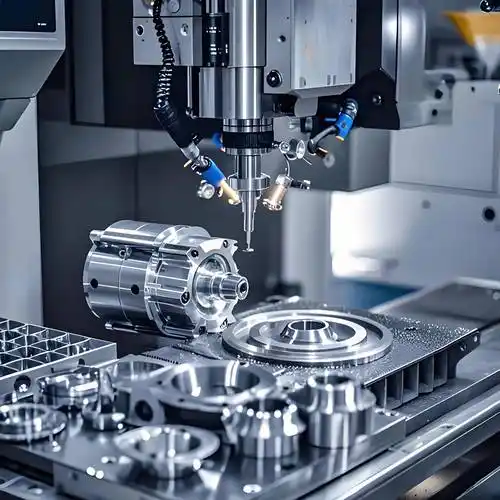
The Core CNC Machining Process Flow
A complete CNC machining process typically follows these key steps:
Step 1: Part Design & CAD Modelling
Engineers create a 3D digital model of the part using CAD software, defining the geometry, dimensions, tolerances, and technical requirements.
Step 2: Process Planning & Programming
The part drawing is analysed to determine the machining strategy and toolpath, including the sequence of operations and division of roughing, semi‑finishing, and finishing cuts. The CAD model is then imported into CAM (Computer‑Aided Manufacturing) software, which generates the toolpath and outputs G‑code that the machine can read.
Step 3: Workpiece Setup & Tool Setting
The raw metal material (e.g., aluminium alloy, stainless steel, titanium alloy) is securely mounted on the machine table. Cutting tools are installed and the tool‑setting operation is performed to establish the exact position of the tools relative to the workpiece.
Step 4: Automated Machining
The CNC program is started, and the machine automatically executes roughing, semi‑finishing, and finishing operations along the predefined toolpaths. Modern CNC machines can achieve tolerances down to IT7 grade, meeting stringent aerospace standards such as AS9100.
Step 5: Inspection & Quality Control
After machining, the finished part is inspected using precision measuring instruments to verify dimensions, surface quality, and compliance with the drawing specifications.
Key Advantages of CNC Machining
1. Exceptional Accuracy & Consistency
The greatest strength of CNC machining is its unmatched precision and repeatability. Modern CNC machines can hold tolerances within ±25 microns (0.025 mm). The computerised control system minimises human error, ensuring that every part – whether you make 100 or 10,000 pieces – meets the same exacting standards.
2. Ability to Machine Complex Geometries
CNC machines can produce intricate 3D surfaces, deep cavities, threads, and irregular hole patterns that are extremely difficult – or impossible – to achieve with manual methods. Because the toolpath is generated directly from the 3D CAD file, manufacturing complex parts becomes both efficient and reliable.
3. High Automation & Productivity
CNC machining offers full automation from programming to finished parts. A single machine can run unattended for extended periods (even overnight), drastically reducing production lead times. The productivity advantage is especially significant for high‑volume production runs.
4. Wide Material Compatibility
CNC machines can handle a vast range of materials – from conventional metals such as aluminium, steel, and copper to advanced composites like carbon‑fibre‑reinforced polymers – meeting the diverse needs of different industries.
Main Types of CNC Machining
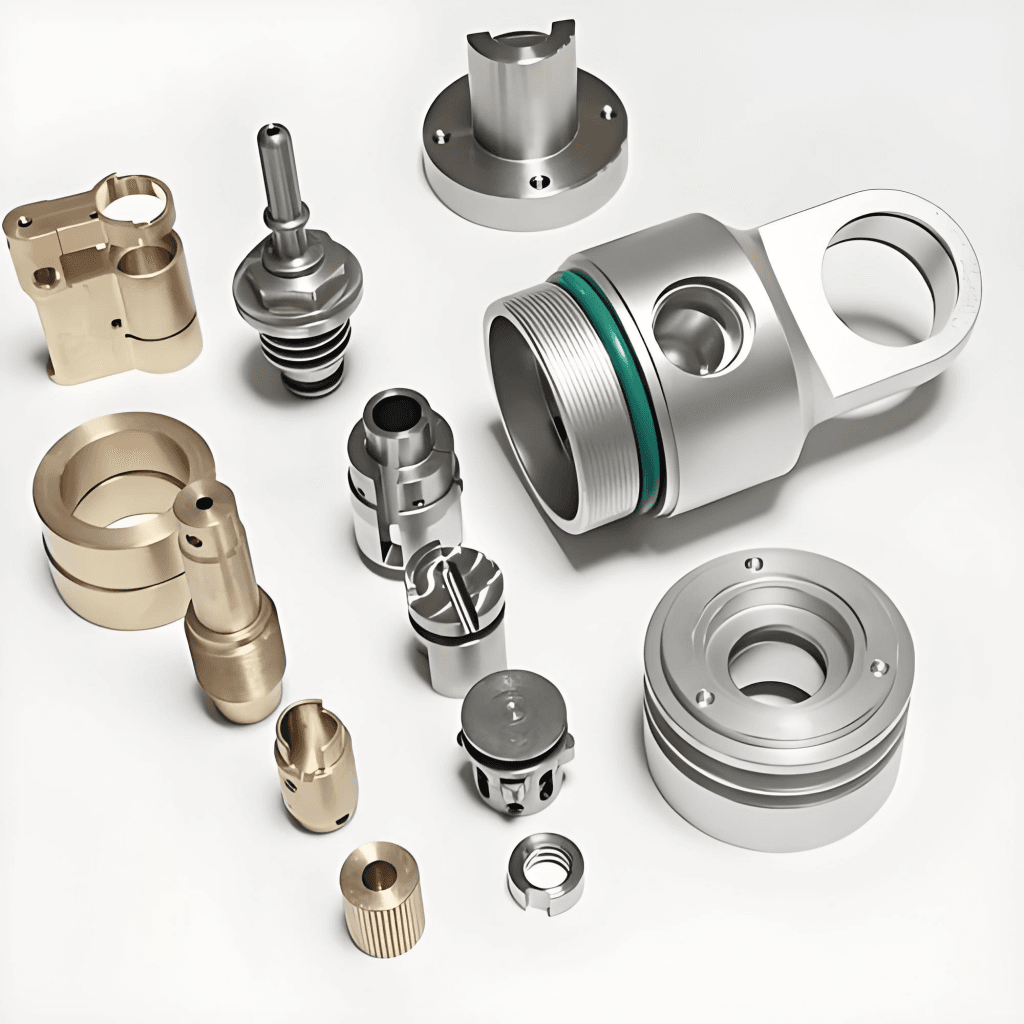
CNC machining covers several process variants, the most common being:
- CNC Milling – Rotating cutting tools move along multiple axes to remove material, creating slots, threads, holes, and complex 3D shapes.
- CNC Turning – The workpiece rotates while a stationary cutting tool moves along its surface – ideal for producing cylindrical or round parts such as shafts, bushings, and tubes.
- CNC Drilling & Tapping – Used for machining precise holes and internal threads.
In addition, large‑format CNC machining technologies can produce oversized parts weighing several tons and measuring metres in length – such as turbine casings and engine blocks.
Major Application Areas
CNC precision machining plays a critical role across numerous industries:
- Aerospace – Machining lightweight structural components, engine parts, and airframe elements from aluminium, titanium, and composites – with extremely tight tolerances and uncompromising reliability.
- Automotive – Production of body panels, engine components, transmission housings, and suspension parts.
- Medical Devices – Using 5‑axis machining to produce patient‑specific implants directly from CT scan data, as well as surgical instruments and orthopaedic components.
- Mould & Die Making – Manufacturing high‑precision metal moulds and tooling for injection moulding, die casting, and stamping processes.
- Consumer Electronics – Producing enclosures, brackets, connectors, and other precision structural parts for smartphones, laptops, and wearables.
Common Challenges & Solutions in CNC Machining
Despite its many advantages, CNC machining can present some challenges in practice:
Machining Vibration (Chatter) – Caused by tool deflection, loose workpiece clamping, or improper cutting parameters.
- Solutions: Reduce depth of cut, adjust feed rate, check clamping rigidity, and use appropriate tool holders.
Tool Wear & Breakage – Tool wear is natural, but rapid wear affects efficiency and quality.
- Solutions: Optimise cutting parameters, use coated tools, select suitable coolant, and implement tool‑life monitoring.
Dimensional Errors – May arise from insufficient machine rigidity, thermal deformation, or incorrect process setup.
- Solutions: Most issues can be avoided through proper process planning, regular machine maintenance, and operator training.
Poor Design for Manufacturability (DFM) – Features such as excessively deep cavities or extremely thin walls increase machining difficulty.
- Solutions: Consider CNC machining limitations early in the design phase – consult with your manufacturing partner for DFM feedback.
Future Trends in CNC Machining
As manufacturing moves towards smart and digital production, CNC machining is evolving in several key directions:
- Multi‑Axis Machining – 5‑axis and even 6‑axis technology is redefining how complex parts are produced, especially for high‑mix, low‑volume, and customised production.
- Smart Automation & AI – Integration with artificial intelligence and the Internet of Things (IoT) enables real‑time process monitoring, adaptive control, and predictive maintenance – improving uptime and quality.
- Green Manufacturing – Optimising toolpaths and cutting parameters to reduce material waste, energy consumption, and coolant usage – supporting sustainability goals.
- Hybrid Manufacturing – Combining additive (3D printing) and subtractive (CNC) processes in a single machine for greater design freedom and material efficiency.
Conclusion
With its unique combination of high precision, high efficiency, and remarkable flexibility, CNC machining has become an irreplaceable core technology in modern metal manufacturing. Whether it is a mission‑critical aerospace component or a precision structural part for a consumer device, CNC machining delivers consistent, reliable quality that meets the most demanding design requirements.
As technology continues to advance, CNC machining will play an even more vital role in the new era of smart manufacturing – helping engineers turn ambitious designs into reality, faster and more affordably than ever before.

Contact Us
Click here: Contact Us
Email: [email protected]
Author:David Wu
video URL:Visit our YouTube to view videos
China Kewei Intelligent Technology Co., Ltd
Address:No. 23, Yexing Road, Xiangxi Industrial Zone, Liaobu Town, Dongguan City, Guangdong Province, China
With our profound expertise in customized sheet metal manufacturing services, CNC milling and turning, and metal stamping processing, we meet the complex needs of the automation equipment industry, new energy storage industry, and manufacturing industry. Our service portfolio includes automation equipment enclosures, precision mechanical parts, energy storage cabinet enclosures, and other customized metal products. We use advanced laser cutting, welding, and forming technologies to produce parts with strict tolerances and excellent surface finish. Whether you need small batch prototypes for research and development or large-scale production for assembly lines, our scalable solutions ensure the quality, cost-effectiveness, and on-time delivery of your industrial projects
相关文章:
 The Complete Guide to Sheet Metal Fabrication: Processes, Materials, and Best Practices
Custom Cut Sheet Metal: A Complete Guide for Buyers and Engineers
The Complete Guide to Sheet Metal Fabrication: Processes, Materials, and Best Practices
Custom Cut Sheet Metal: A Complete Guide for Buyers and Engineers
 Custom Metal Enclosures in China: Your Complete Guide to OEM Sheet Metal Housings
 Custom Sheet Metal Solutions: What Kewei Can Do for Your Business