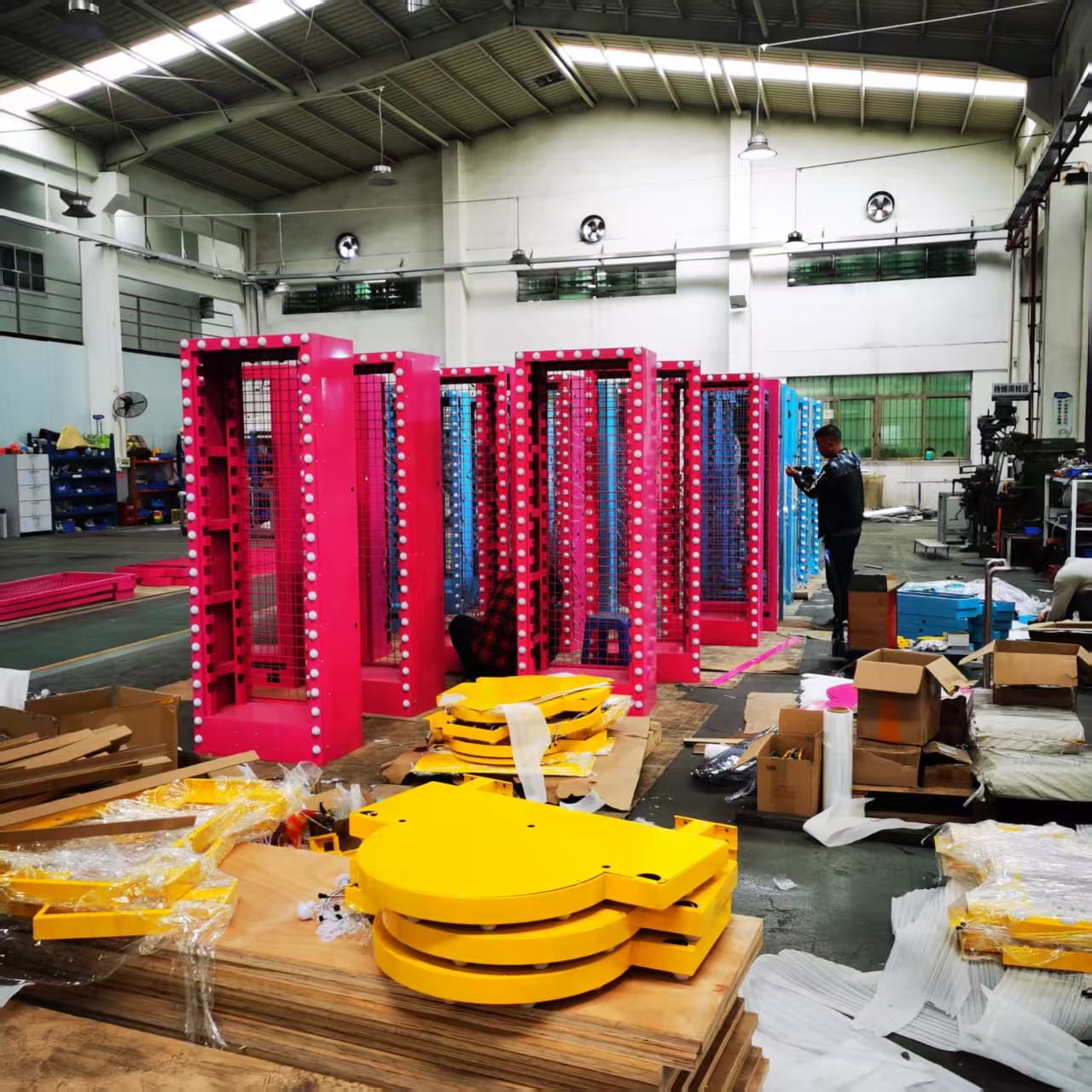
Arcade machines, claw machines, and pinball machines may look like “fun” products on the outside—but from a sheet metal fabrication standpoint, their requirements are actually quite demanding.
A single machine is assembled from dozens—sometimes hundreds—of sheet metal components: door frames, lock holes, panel screw holes, screen mounting positions. If any hole is off by half a millimeter, the assembly line has to file it out on the spot. One machine takes half a day to fix, and the day’s shipping schedule is ruined.
What’s more, entertainment equipment isn’t purely sheet metal. Acrylic panels, lighting, screens, locks, and internal hardware all have to fit precisely onto the same cabinet. The sheet metal parts serve as the structural “skeleton”—if their dimensions get out of control, everything downstream falls apart.
This article looks at the real pain points in arcade machine sheet metal fabrication and the practical solutions that address them.

Pain Point 1: Holes Don’t Line Up—The Machine Won’t Assemble
This is the most common problem found during incoming inspection of arcade equipment sheet metal. Each individual panel looks flat and the coating looks great—but when you assemble the machine, the door frame won’t close flush, the lock holes don’t align, and the panel screw holes are half a position off.
The problem originates in the cutting and bending stages. With shearing plus punch press hole punching, the shear itself has a straightness error, and the punch requires secondary positioning. The two errors stack up—and by the time the part reaches assembly, it’s misaligned.
The bending stage is even more subtle. For the same panel, different bend sequences, different die wear, and different springback compensation can change the developed length by one or two millimeters. After flanging, the hole positions shift as a whole.
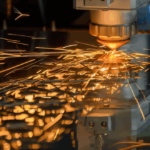
The solution: Use laser cutting for the cutting stage, with positioning accuracy controlled at the 0.01mm level to ensure the relative positions between holes remain stable. On the bending side, the key isn’t “buying good equipment”—it’s building a parameter file per model and reusing it. Each model gets a fixed set of bend coefficients and die parameters, rather than relying on operator feel. Change the die, change the operator—but the parameters stay on file, so hole positions remain consistent batch after batch.

Pain Point 2: Welding Distortion Pulls Aligned Holes Apart Again
During cabinet welding, localized heating and cooling contraction pull already-aligned holes out of position—especially on thin-gauge cabinets. Arcade machine cabinets typically use 1.2–2.3mm material, which has limited rigidity. Once welding heat input gets too high, distortion becomes uncontrollable.
The solution: Control the welding sequence and current. Use symmetrical, staggered welding—tack-weld first, then complete the full seam—to keep heat input down. A more systematic approach is to use dedicated welding fixtures: calibrate the cabinet’s four corners diagonally before tack welding, clamp the assembly in place, then weld. After welding, re-check critical hole positions and send out-of-tolerance parts to rework—never let them flow into painting with defects.
For door frames and door panels—components with high fit-up precision requirements—use dedicated fixtures for both bending and welding to ensure consistent left-right door gaps.
Pain Point 3: Diagonal Tolerance Out of Control—The Cabinet Twists
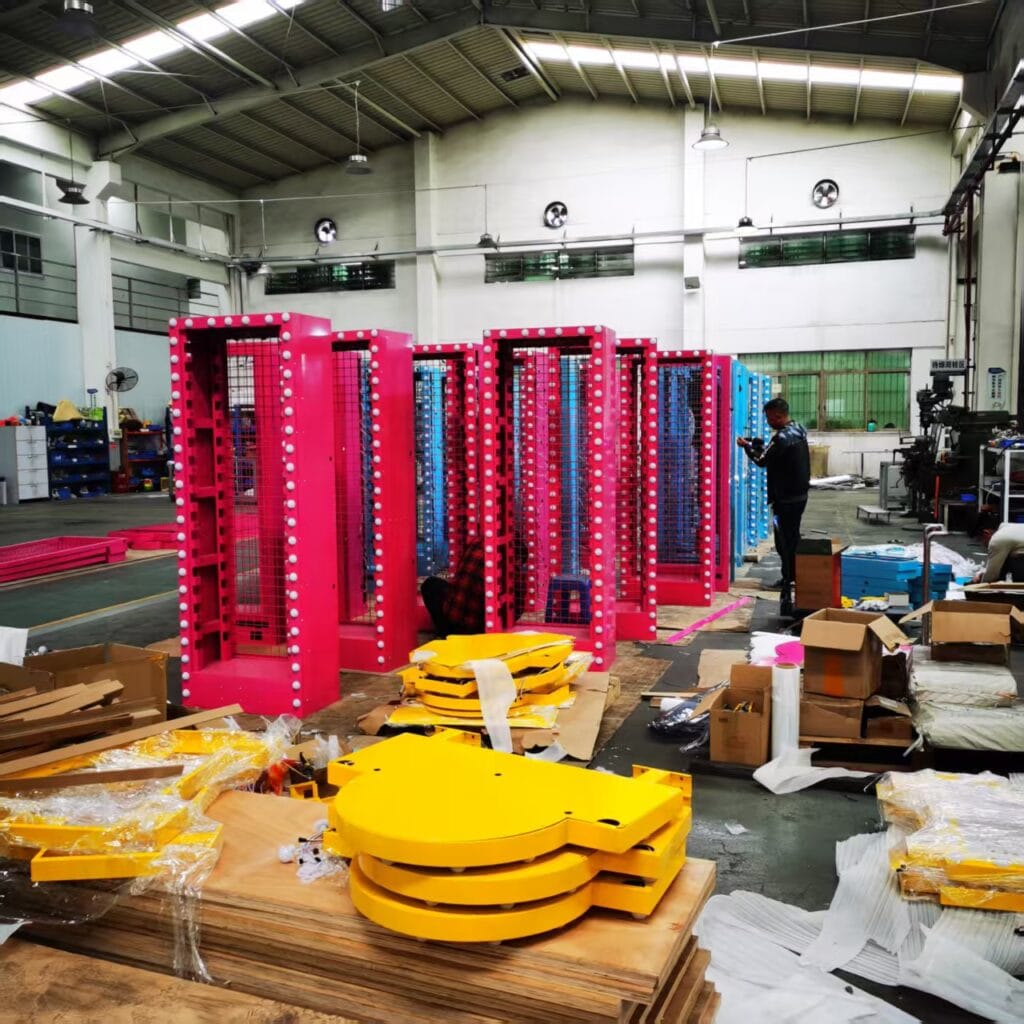
An arcade machine cabinet isn’t a simple box. It has a front opening, internal partitions, and screen mounting positions. If diagonal tolerances on length, width, and height aren’t controlled, the frame twists. The door fits tight on one side and loose on the other. The screen doesn’t sit parallel to the panel.
The solution: Include diagonal dimensions in the first-article inspection checklist, controlling to ≤1mm per project requirements. In batch production, four-corner diagonal calibration before welding is a mandatory step—not something to sort out after the finished product is built. Use door panel fixtures for both bending and welding to ensure the door frame matches the cabinet dimensions.
Pain Point 4: Sheet Metal Is Just the Skeleton—Acrylic and Wood Integration Is the Real Test
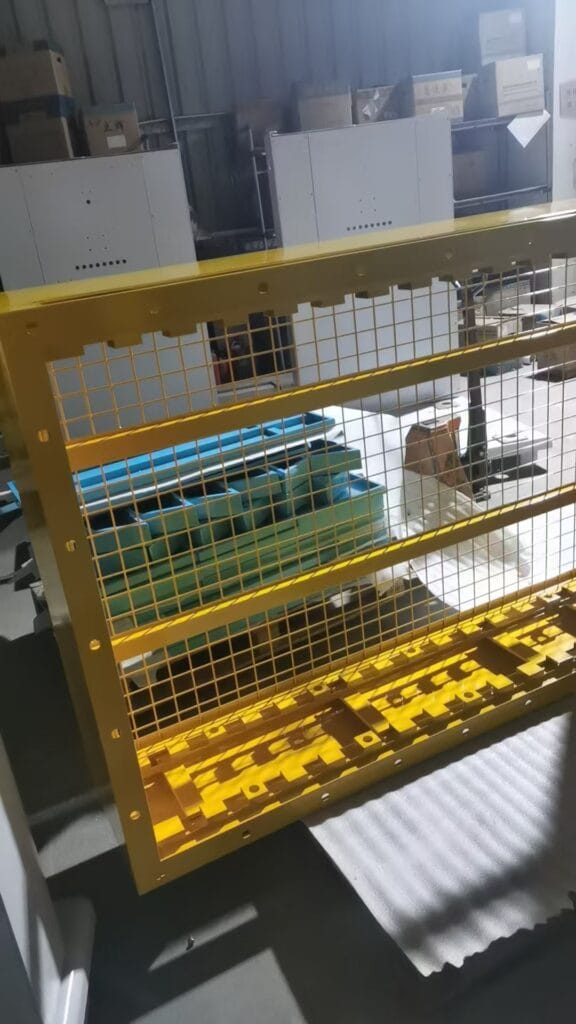
Entertainment equipment is rarely pure sheet metal. Claw machine prize chutes need clear acrylic panels. Pinball machine tracks need wood or plastic components. Arcade machine lighting and screens require precisely positioned cutouts in sheet metal panels.
Sheet metal provides structural strength and mounting datums. Acrylic and wood provide appearance and function. The fit-up gaps between the three directly determine the machine’s perceived quality.
The solution: Work with a fabrication partner that offers multi-material integration capabilities. The sheet metal side handles precise cutouts, bending, and mounting datum control. The acrylic side handles cutting, engraving, and heat bending. Wood components handle side panels and decorative structures. Final assembly happens on the metal frame.
If the sheet metal shop only does sheet metal—and acrylic and wood go to separate suppliers—the cost of coordinating the dimensional chain rises sharply, and when problems occur, suppliers tend to point fingers at each other.
Pain Point 5: Durability in High-Frequency Use Environments
Arcade machines and claw machines sit in shopping malls and entertainment centers. Dozens or hundreds of people touch, tap, and operate them every day. Edge treatment, coating adhesion, and the mounting strength of locks and hinges directly affect equipment lifespan and maintenance frequency.
The solution: Don’t cut corners on surface treatment. A proper process includes multi-stage chemical cleaning, deburring, and powder coating to ensure coating adhesion and edge safety. Door frames and panel edges must be deburred and rounded to avoid cutting users. Lock and hinge mounting locations need reinforced structures designed in at the sheet metal stage—not relying on thin sheet alone to bear the load. Welding and fastener selection must match high-frequency use scenarios, not “static display cabinet” standards.
Contact Us
Click here: Contact Us
Email: [email protected]
Author:David Wu
URL: https://zhmfr.com
video URL:https://www.youtube.com/@David-OEM
China Kewei Intelligent Technology Co., Ltd
Address:No. 23, Yexing Road, Xiangxi Industrial Zone, Liaobu Town, Dongguan City, Guangdong Province, China
With our profound expertise in customized sheet metal manufacturing services, CNC milling and turning, and metal stamping processing, we meet the complex needs of the automation equipment industry, new energy storage industry, and manufacturing industry. Our service portfolio includes automation equipment enclosures, precision mechanical parts, energy storage cabinet enclosures, and other customized metal products. We use advanced laser cutting, welding, and forming technologies to produce parts with strict tolerances and excellent surface finish. Whether you need small batch prototypes for research and development or large-scale production for assembly lines, our scalable solutions ensure the quality, cost-effectiveness, and on-time delivery of your industrial projects.
相关文章:
 Waterproofing Outdoor EV Charging Stations and Energy Storage Cabinets: 6 Key Sheet Metal Solutions
 The Complete Guide to Sheet Metal Fabrication: Processes, Materials, and Best Practices
Custom Cut Sheet Metal: A Complete Guide for Buyers and Engineers
 The difference between sheet metal Fabrication and 3D printing: Which One Should You Choose?